
Dayton, OH and the Miami Valley
Composite Decking in Huber Heights, OH
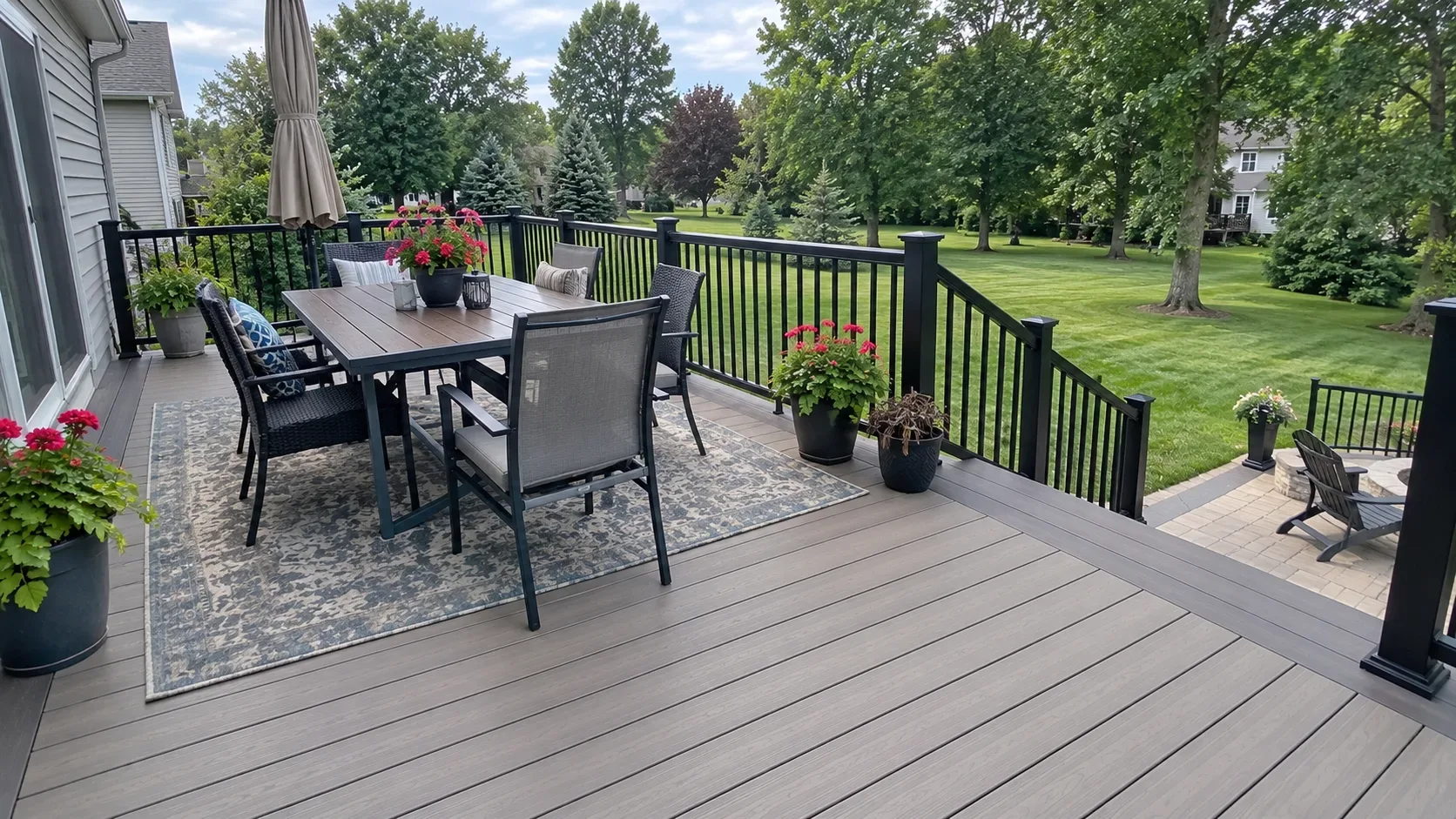
Capped composite and PVC decking installed over a frame built for it. No sealing, no staining, and a surface that still looks the same colour in ten years.
- Footings below the frost line
- Permits and inspections handled
- Written scope before we start
Composite Decking planning range for Huber Heights
Typical price range
From:$19,000To:$29,000
- Frame and decking$14,800–$21,600
- Railing, 52 ft$3,400–$4,900
- Stairs, 1 run$800–$2,500
Planning range, not a quote. It assumes a typical deck; very tall decks and hard access need a site visit before anyone can give a firm price.
Dayton Custom Decks plans composite decking in Huber Heights, OH. Composite decking is a material and drainage decision, not simply a board-color decision.
Choose the board system with the whole deck
The scope should name the board line, color, hidden-fastener system, joist spacing, picture-frame details, fascia and the condition of the framing below. A low-maintenance surface still relies on a dry, sound structure.
Plan heat, drainage and transitions
Review sun exposure, airflow, stair connections and where water leaves the house before selecting a color. Dark boards can run hotter and a capped board does not fix water held against old framing.
What changes for composite decking in Huber Heights
Huber Heights has wide mid-century lots and replacement projects on ranch and two-story homes. Homeowners can assume a replacement uses the old approval path even when the footprint, height or roof changes.
Huber Heights publishes city permit information, while larger structural work can also involve Montgomery County Building Regulations. For this address, the first useful decision is to measure the old structure and define exactly what changes before calling it a replacement.
Research checkpoint for this Huber Heights project
Composite material performs best when the supporting frame and drainage are verified first. In Huber Heights, that concern meets a specific local condition: wide mid-century lots and replacement projects on ranch and two-story homes. This changes the questions that belong in the first site visit.
Use the local site condition to decide whether resurfacing is reasonable or the scope needs new framing. The page research therefore asks one project-specific question: Is this a same-footprint repair, or does the new plan change size, height or loading?
Local source: Huber Heights permits. Checked October 7, 2026.
Questions for the first site visit
- Is the existing frame suitable for the selected composite system?
- Where will water leave the deck and house connection?
- Which color and surface finish fit the sun exposure?
- Is this a same-footprint repair, or does the new plan change size, height or loading?
Composite Decking planning range for Huber Heights
Why homeowners pick Dayton Custom Decks
Footings below the frost line
Ohio ground heaves. Every post we set lands on a poured footing below the local frost depth, which is what keeps a deck level through a decade of freeze and thaw.
Permits and inspections handled
We pull the permit, meet the inspector and hand you the signed card. An unpermitted deck becomes your problem the day you sell the house.
Written scope before we start
Materials, framing spec, hardware, timeline and price in writing before anybody swings a hammer. No verbal change orders.
Composite Decking questions we get asked
Is composite decking worth it over pressure treated?
Over a twenty year horizon in Ohio, usually yes. A treated deck needs cleaning and resealing every two to three years. At Huber Heights labour rates that is a real recurring cost, and most people skip it, which is why treated decks look tired by year eight. Composite costs roughly 60 to 90 percent more up front and then costs you a wash down twice a year. If you plan to sell inside five years the maths is less clear.
Does composite decking get hot in the sun?
Yes, and colour matters more than brand. A dark board on a south or west facing deck in July gets hot enough to be uncomfortable barefoot. Lighter greys and tans run noticeably cooler. Some Deckorators mineral based boards and TimberTech's Azek PVC lines are engineered to run cooler than standard composite. We will tell you which way your deck faces before you pick a colour.
Who issues a deck permit in Huber Heights?
The city handles zoning and property questions, but the building permit for a deck over 200 square feet or more than 30 inches above grade goes through Montgomery County Building Regulations. Below both of those, a deck can be built without a county building permit, though the city still has setback and zoning rules that apply. It catches people out because they call the city expecting the whole answer and the city points them at the county. We work out which desk applies before we price anything.
Do I need a permit for a small ground level deck?
Under 200 square feet and no more than 30 inches above grade at any point, no county building permit is triggered, assuming the deck does not serve a required exit. That is a real saving in time and paperwork on the many ranches here with a low rear door. What does not go away is zoning. Setbacks and lot coverage still apply, and the city's Planning and Zoning office can confirm them. We check both before drawing.
What should be checked before hiring composite decking in Huber Heights?
Measure the old structure and define exactly what changes before calling it a replacement. The builder should also confirm the scope, existing condition and the approval route before work starts. Use the local site condition to decide whether resurfacing is reasonable or the scope needs new framing.