
Dayton, OH and the Miami Valley
Deck Builders in Xenia, OH
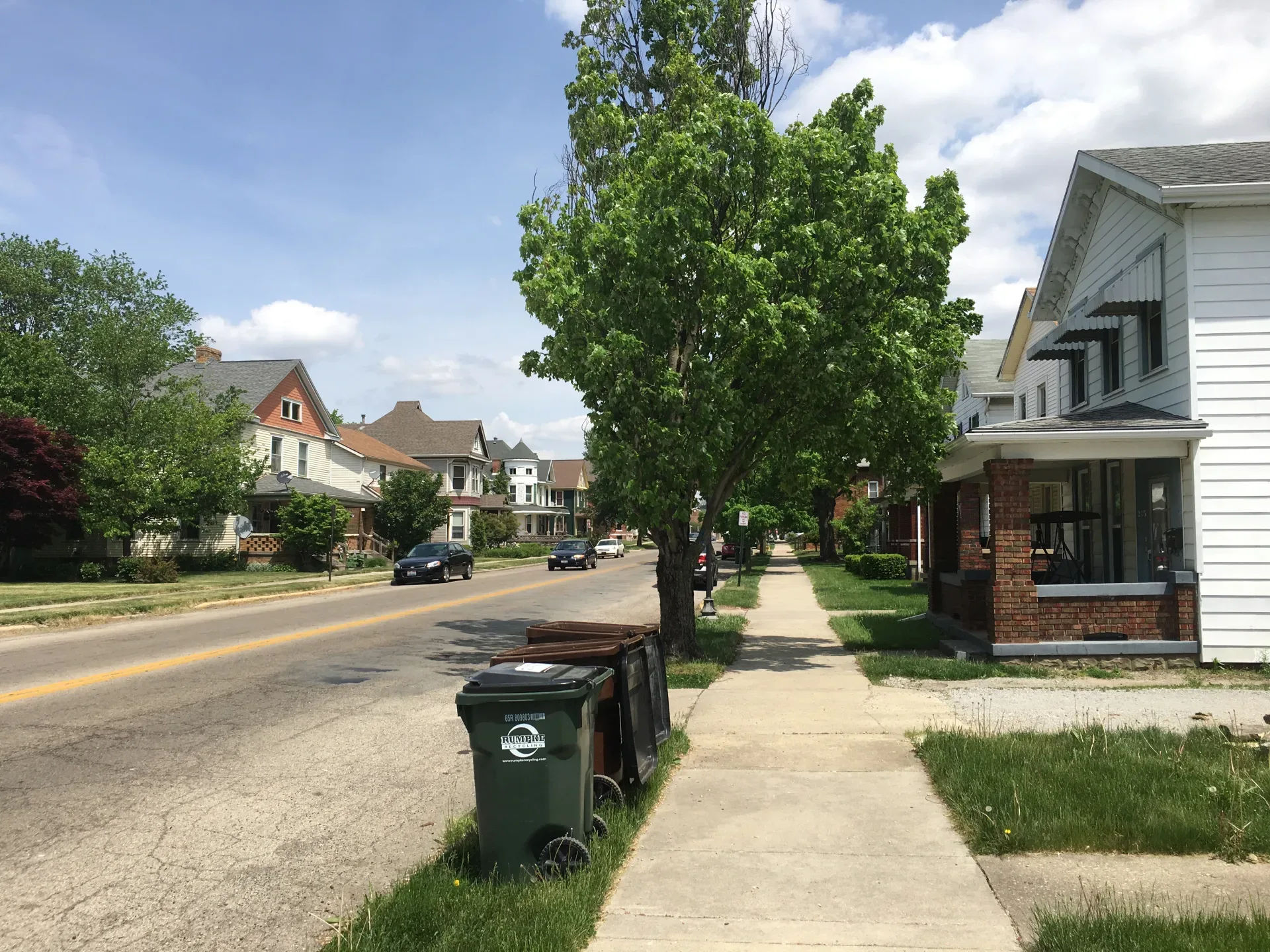
The Greene County seat, rebuilt after the 1974 tornado, with a heavier tree canopy than anywhere else in the metro. Shade and damp decide how a Xenia deck ages, not the sun.
- Footings below the frost line
- Permits and inspections handled
- Written scope before we start
Photo: LittleT889 / Wikimedia Commons (CC BY-SA 4.0)
Dayton Custom Decks builds and repairs decks throughout Xenia, Ohio.
Xenia is the Greene County seat, and it is the only town in the metro that has been rebuilt from the ground up in living memory. The tornado of 1974 took the downtown, and what went back has shaped the housing, the trees and the way decks here age. A Xenia deck is usually a shaded deck, and shade changes everything.
Xenia was rebuilt once, and the housing stock shows it
The storm that reset the town
On the third of April in 1974, an outbreak of tornadoes crossed Ohio, and Xenia took a direct hit. The downtown was largely destroyed and much of the town had to be rebuilt. That is why Xenia looks the way it does today: a compact historic core around the courthouse, surrounded by housing from two clearly different eras.
Two eras of housing in one town
There are the older homes that survived or were built before the storm, concentrated near the centre and along the older streets, and there is the large body of housing that went up in the years after, on slabs, on crawl spaces and over basements. The post 1974 stock is generally more uniform, with decks added later, often by the first or second owner rather than by the builder.
The county seat and its older core
As the county seat, Xenia holds the courthouse, the county offices and a genuinely walkable downtown, with older housing around it. Those older homes have smaller lots, mature plantings and decks that have been altered several times. The wood is often original and the framing has been patched, so the first task on a repair here is to work out what is still carrying load and what is just along for the ride.
What rebuilding taught the town about wind
A town that has been through that kind of storm does not treat uplift casually. Decks here benefit from proper connection: joists tied to the beam, the beam tied to the posts, and the posts set in real footings rather than resting on grade. It is not about a tornado arriving next week. It is about normal Ohio wind loading and about a structure that stays put for twenty years.
The trail hub and homes near the old line
Xenia is one of the best connected towns in Ohio for trails, with the old rail corridors meeting near the centre and the Little Miami Scenic Trail passing through. That matters to decks more than it sounds. Homes near the trail and the older rail corridors tend to sit on narrower lots with mature trees, and many of them back onto green space rather than another house.
A deck that looks onto a trail or a tree line is used differently from one that looks at a neighbouring wall. Privacy and screening matter more, and so does the view line, which usually means a guard with a thin profile rather than a solid wood panel. It is a small design decision that gets made at the estimate or not at all.
Tree canopy and the damp deck problem
Why Xenia decks stay wet
Xenia carries a heavier tree canopy than the rest of the metro, some of it older than most of the houses. That shade is a real asset in July. It is also the single biggest reason decks here age faster than decks out on open ground. Boards under canopy stay damp for hours after rain and through the dew, and a surface that never fully dries is a surface that grows things.
Moss, algae and the slippery surface
The first symptom is green. Moss and algae take hold in the shaded gaps and on the north faces, and once they are established the surface becomes slick, especially on a shallow step or a stair. A deck that was safe when it was installed becomes a fall risk without anything structural having failed. Cleaning and resealing restores the grip, and it is the cheapest repair on this page.
Debris in the gaps and the gutter line
Leaves, seed pods and twigs collect between the boards and against the ledger, and they hold moisture exactly where wood is most vulnerable. On a shaded lot the debris load is constant from spring through autumn. Keeping the gaps clear and the drainage path open is not cosmetic work. It is the difference between a frame that lasts and one that rots from the top down.
What a shaded deck needs that a sunny deck does not
A deck in full sun dries after rain, so treatment intervals can stretch. A deck under canopy needs shorter intervals, a surface that resists algae, and attention to airflow. That points toward either a disciplined staining schedule on wood or a capped surface that does not absorb water. It also argues for leaving the space under the deck open so the joists can dry between storms.
What long damp does to the fasteners
Wood is not the only material that suffers under canopy. Fasteners and connectors that stay wet corrode faster, and the first sign is usually a dark stain running down the face of a board below a joist hanger or a bolt. On an older Xenia deck the fixings are often plain steel that has been wet for years.
That is why we use hot dipped or stainless hardware where a deck stays damp, and galvanised connectors throughout. It is a small line in the material list and it is the reason a shaded deck can still reach twenty years without a joist hanger letting go. If you are replacing boards over an old frame, the fasteners are worth replacing at the same time.
Repair and replacement work we do most in Xenia
Staining and sealing on shaded decks
Under canopy, a wood deck needs cleaning and resealing more often than the label suggests. We strip the old finish, treat the algae, and reseal with a product suited to a damp, shaded surface. See deck staining and sealing for what that cycle looks like across a year.
Re decking and board replacement
Where the frame is sound and the boards have gone, re decking is the value play. On a shaded Xenia deck we often find the outer boards and the ones near the stair have failed first while the frame underneath is dry and solid, which makes the repair smaller than the homeowner expected. We check the whole frame before we price it, so the estimate covers what is actually there.
Framing repair after long damp
Where water has been sitting in the debris line for years, the damage moves into the rim joist, the ledger and the tops of the posts. That is deck repair that has to be done before any new surface goes down, and it is worth doing properly, because covering damp framing with new boards only hides the problem until the next owner finds it.
Guards, stairs and railings
Wood guards on shaded decks rot at the base of the posts and at the connection to the deck edge. An aluminium or steel guard removes that failure point, keeps the profile thin, and never needs painting. On stairs, the stringer and the handrail get the least sun and the most wear, so they are the parts we check first on any older Xenia deck.
When repair stops making sense
There is a point where repair stops being sensible. The rule we use is simple. If the frame is sound, the ledger is dry and the posts are on real footings, repair wins, and re decking is the best value on this page. If the frame has rot in the ledger, the posts or the outer beam, money spent on a new surface is money spent on a structure that is already failing.
On a damp, shaded lot that line arrives sooner than on a sunny one, because the same moisture that ruins boards works on framing. We would rather tell an owner that a deck is a rebuild than sell a re deck that lasts three years. The inspection underneath comes with the estimate, and it decides the answer.
Building a new deck in Xenia
Choosing a material for a damp, shaded lot
Shade is the deciding factor. Treated pine and cedar can work here, but they demand a real sealing schedule, and under heavy canopy that schedule is short. Composite and capped PVC handle damp and shade far better because they do not absorb water, do not support algae the way bare wood does, and do not need resealing. On a lot that never dries out, that is usually worth the higher material cost.
Where the canopy decides the layout
A mature tree is not an obstacle to be cleared. It is the shade that decides where a deck is comfortable and where it is not. We plan the deck around the canopy: where the sun reaches at four in the afternoon, where the root plate sits, and where the structure can go without cutting the roots that hold the tree up. Footing locations near a large tree need thought, because digging into a root plate damages the tree slowly rather than all at once.
Screening, covering and lighting under trees
Shade and canopy come with two side effects. The first is that a covered or screened space stays darker, so lighting matters more here than on an open lot. The second is that a roof catches falling leaves, so gutter and roof detailing has to be able to shed them. A screened porch suits a shaded lot well, because the canopy already does much of the cooling and the screen keeps the insects out of the evening.
Sizing and shaping around shade
On a shaded lot the usable part of a deck is the part that is comfortable, and that is rarely the whole rectangle. Sun moves across the yard through the day, so the morning deck and the afternoon deck can be two different corners of the same plan. We look at the shade at different hours before fixing the shape, because a deck sized only for furniture and placed in the wrong spot will sit empty.
The other local habit worth breaking is building to the property line because there is room. On the older Xenia lots the tree and the neighbour are close, and a smaller deck in the right place gets far more use than a larger one in the shade. Where the canopy is heavy, a covered section is often unnecessary, because the trees already do that job.
Permits, review and the Greene County seat
The City of Xenia and Greene County
Xenia is the Greene County seat, and the city reviews building permits for decks within its limits, while parcels outside the city fall to the county or a township. An attached deck needs a permit, and the review covers structure, setbacks and lot coverage. Because this is the county seat, the records side is straightforward once we know which jurisdiction the address falls in. We identify that before quoting.
Storm, wind and footing considerations
Greene County soil is clay, and clay holds water and carries less load per square foot than granular soil, so footings sometimes need a wider pad than the code minimum. Combined with the wind concern that any long established town understands, that means a deck here is only as good as what is underground. We pour to frost depth and size the footing for the actual soil rather than a default.
What to bring to the estimate
Photographs of the deck from underneath are the most useful thing a homeowner can send, because the frame is where the money is decided. If the deck is old, tell us when it was last sealed and whether water sits on the boards after rain. If you are near a large tree, say so at the first call, because it changes the footing plan and it may change the shape of the deck.
Getting started in Xenia
Tell us where the deck sits relative to the trees and how much shade it gets. We will check the frame, the guard and the drainage path, then price the options that actually apply: a clean and reseal, a partial re deck, or a full replacement in a surface that suits a damp lot. The estimate is free and the scope is written.
General ranges are on the deck cost guide.
Why homeowners pick Dayton Custom Decks
Footings below the frost line
Ohio ground heaves. Every post we set lands on a poured footing below the local frost depth, which is what keeps a deck level through a decade of freeze and thaw.
Permits and inspections handled
We pull the permit, meet the inspector and hand you the signed card. An unpermitted deck becomes your problem the day you sell the house.
Written scope before we start
Materials, framing spec, hardware, timeline and price in writing before anybody swings a hammer. No verbal change orders.
Neighbouring communities we build in
Xenia sits in Greene County. Deck rules change from one jurisdiction to the next, so these are the communities next door and who issues the permit in each.
- Oakwood, OH in Montgomery County
- Kettering, OH in Montgomery County
- Centerville, OH in Montgomery County
- Beavercreek, OH in Greene County
- Springboro, OH in Warren County
- Huber Heights, OH in Montgomery County
- Miamisburg, OH in Montgomery County
- Fairborn, OH in Greene County
- Vandalia, OH in Montgomery County
- Troy, OH in Miami County
- Piqua, OH in Miami County
- Lebanon, OH in Warren County
- Bellbrook, OH in Greene County
- Yellow Springs, OH in Greene County
Deck questions from Xenia homeowners
Why do decks in Xenia rot faster than decks outside town?
Tree canopy. Under heavy shade a deck stays damp for hours after rain and through the overnight dew, and a board that never fully dries is a board that grows moss, algae and eventually rot. Decks out on open farmland dry within an hour and last far longer on the same maintenance schedule. Shade is a real asset in July, but it changes the treatment cycle and it points most homeowners toward a surface that does not absorb water.
How often should a shaded wood deck be sealed in Xenia?
More often than the product label suggests, and more often than a deck in full sun. Clean and reseal every year to eighteen months is realistic under heavy canopy, and the cleaning matters as much as the sealer, because algae has to be killed before anything goes over it. If a deck is left three or four years between treatments here, the boards grey out, the gaps open and the frame starts to take on water.
Is composite worth it under heavy tree cover?
It usually is, because the case against composite is cost and the case for it here is the maintenance you avoid. Composite and capped PVC do not absorb water, do not feed algae the way bare wood does, and never need resealing. What they do need is cleaning, because leaf tannin and pollen leave marks on any surface. Under a canopy that is a wash with a brush once a year rather than a full strip and seal.
Who issues a deck permit in Xenia?
Xenia is the Greene County seat, so decks inside the city go through the city building review, while parcels outside the city fall to Greene County or to a township. An attached deck needs a permit, and the review covers structure, setbacks and lot coverage. It is a different process from the Montgomery County side of the metro. We identify which jurisdiction applies to the address before we quote, so the timeline is honest.
Do I have to remove a tree to build a deck in Xenia?
No, and we would rather plan around it. A mature tree is what makes a shaded lot comfortable, and cutting one to fit a deck is usually the wrong trade. The real constraints are the root plate and the canopy. Digging a footing inside the root plate damages the tree slowly, so footing locations get moved, and the deck shape follows the shade line rather than fighting it. Where a branch is genuinely in the way, a certified arborist is a separate call.
The 1974 rebuild left a mix of housing here. How does that affect repairs?
It splits the town into two repair conversations. The older homes near the centre have original framing that has been patched over the years, so the first job is working out what is still carrying load. The post 1974 housing is more uniform, with decks usually added later by an owner rather than the builder, which means the deck quality varies more than the house does. Both need a look underneath before anything is priced.