Dayton, OH and the Miami Valley
Composite Decking in Dayton, OH
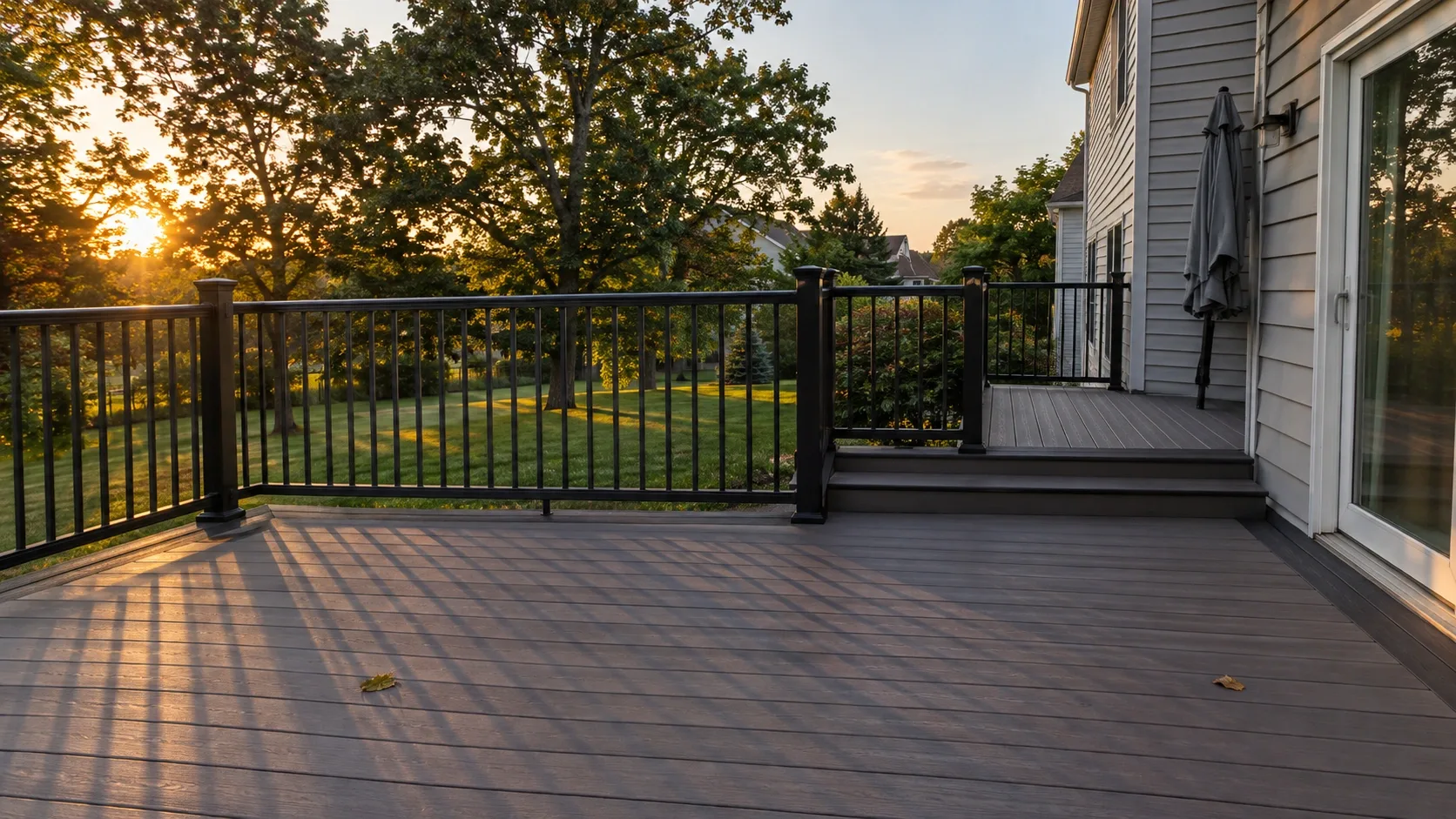
Capped composite and PVC decking installed over a frame built for it. No sealing, no staining, and a surface that still looks the same colour in ten years.
- Footings below the frost line
- Permits and inspections handled
- Written scope before we start
Apex Decks installs capped composite and PVC decking throughout Dayton and the Miami Valley. Trex, TimberTech, Fiberon and Deckorators, over a frame built to the spacing those boards actually need.
Composite solves the problem most homeowners here really have, which is not that the deck fell down but that it went grey and needed sanding every other spring.
The product lines we install
Trex
The name most people know. Enhance is the entry line and does the job on a budget. Transcend and the Lineage colours sit above it with better colour depth and a heat reducing formulation. Trex boards are wood flour based and capped on three or four sides depending on the line.
TimberTech and Azek
TimberTech’s composite lines run close to Trex on price and performance. The difference is Azek, their capped PVC, which has no wood content at all. No wood means nothing for mould to feed on inside the board and a much lighter board. It is the most expensive option we fit and carries the longest warranty.
Fiberon
Concordia and Good Life are the lines we fit most. Fiberon competes on colour realism, and their darker multi tonal boards look convincing next to real wood in a way that the entry tier of any brand does not.
Deckorators
Their mineral based composite is the outlier worth knowing about. It does not absorb water, is dimensionally stable in a way wood flour composites are not, and runs cooler underfoot. It also happens to be the one product line where a dark colour on a south facing Dayton deck is a defensible choice.
How we install it
Frame built to the board’s spec
Before any composite goes down we confirm the joist spacing against the manufacturer’s installation instructions, not against habit. Sixteen inches on centre for a standard perpendicular layout, twelve for a diagonal, twelve for stair treads. Where an existing frame is at 24 inches, we sister in additional joists or tell you the frame needs replacing.
Joist tape on every joist and beam
Butyl tape capping the top edge of every framing member. It seals around each fastener penetration and stops water sitting in the screw hole. On a fifty year PVC deck, the frame becomes the thing that fails first, and tape is the cheapest way to push that out by a decade.
Hidden fasteners
Grooved boards get a hidden clip system that sets a consistent gap and leaves no screw heads in the field of the deck. Face screwing a grooved board is faster and it looks like what it is. Perimeter boards and stair treads get face fastened with colour matched screws where the system requires it.
Correct gapping
Composite moves with temperature. End to end gaps are set from the manufacturer’s table using the temperature on the day of install, which is why a deck laid in February is gapped differently to one laid in August. Boards butted tight in winter will buckle in July.
Picture framing and fascia
A border board around the perimeter hides the cut ends of the field boards and is where a composite deck starts looking finished rather than merely covered. Fascia closes the rim. Both are worth doing and both need blocking in the frame, which has to be planned before the frame is built rather than after.
Composite against the alternatives
Against pressure treated
Treated costs roughly half as much installed. It then needs cleaning and resealing every two to three years to stay looking right, and it will splinter and check regardless. Composite costs more once and then costs almost nothing. The crossover point in total cost of ownership lands somewhere around year ten to twelve at current Dayton material and labour prices.
Against cedar
Cedar is the better looking material on day one and most people prefer real wood grain up close. It is also soft, dents under furniture, greys quickly without maintenance and costs more than treated. Composite wins on longevity, cedar wins on the first summer.
Against capped PVC
PVC is lighter, cooler, fully waterproof and carries the longest warranties. It is also the most expensive and some people find the surface reads as less convincing than a good composite up close. On a rooftop deck, a pool surround or anywhere water sits, PVC is the right answer.
What it costs and what drives the number
The board is roughly a third of the installed cost. The rest is the frame, the footings, the railings, the stairs and the labour, and those do not get cheaper because you chose a premium board. That is why upgrading from an entry composite to a mid tier composite often adds less to the total than people expect, while adding a second stair run or a tall railing adds more.
Railings are the other lever. An aluminium railing system typically runs $70 to $110 per linear foot installed, so a deck with a long perimeter can carry as much railing cost as decking cost. On a low deck under 30 inches we can often skip guards entirely, which is a real saving.
Maintenance, honestly
Wash it twice a year with a composite cleaner and a soft brush. Clear leaves out of the board gaps before winter, because rotting leaf litter sitting in a gap is what causes staining and surface mould. Do not use a pressure washer at close range on the surface cap, and do not use a metal shovel to clear snow, use a plastic one.
That is the whole list. There is no sanding, no sealing and no staining.
Where we install composite decks
We fit composite decks across Dayton, Oakwood, Kettering, Centerville, Beavercreek and Springboro. Composite is the default choice in the Centerville and Springboro subdivisions where HOA review favours a consistent finished look, and it is the usual answer on a walkout deck where an under deck drainage system turns the space below into dry patio.
Deck cost in Dayton, OH
| Tier | Example products | Decking installed, per sq ft | Warranty on fade and stain |
|---|---|---|---|
| Entry capped composite | Trex Enhance, TimberTech Prime+ | $38 to $52 | 25 years |
| Mid capped composite | Trex Transcend Lineage, Fiberon Concordia | $50 to $68 | 25 to 30 years |
| Premium composite | TimberTech Legacy, Deckorators Voyage | $62 to $85 | 30 to 50 years |
| Capped PVC | TimberTech Azek Vintage, Trex Signature | $70 to $95 | 50 years |
| Add: hidden fastener system | Included in our pricing | Included | Matches board warranty |
Ranges are typical installed prices for the Miami Valley and include footings, framing, decking, railings and stairs unless noted. Your written estimate is the number that counts.
Why homeowners pick Apex Decks
Footings below the frost line
Ohio ground heaves. Every post we set lands on a poured footing below the local frost depth, which is what keeps a deck level through a decade of freeze and thaw.
Permits and inspections handled
We pull the permit, meet the inspector and hand you the signed card. An unpermitted deck becomes your problem the day you sell the house.
Written scope before we start
Materials, framing spec, hardware, timeline and price in writing before anybody swings a hammer. No verbal change orders.
Composite Decking questions we get asked
Is composite decking worth it over pressure treated?
Over a twenty year horizon in Ohio, usually yes. A treated deck needs cleaning and resealing every two to three years. At Dayton labour rates that is a real recurring cost, and most people skip it, which is why treated decks look tired by year eight. Composite costs roughly 60 to 90 percent more up front and then costs you a wash down twice a year. If you plan to sell inside five years the maths is less clear.
Does composite decking get hot in the sun?
Yes, and colour matters more than brand. A dark board on a south or west facing deck in July gets hot enough to be uncomfortable barefoot. Lighter greys and tans run noticeably cooler. Some Deckorators mineral based boards and TimberTech's Azek PVC lines are engineered to run cooler than standard composite. We will tell you which way your deck faces before you pick a colour.
What joist spacing does composite decking need?
Most capped composite needs joists at 16 inches on centre for a perpendicular layout and 12 inches on centre for a 45 degree diagonal. Some products and all stair treads want 12 inches regardless. Framing at 24 inches and then laying composite over it produces a bouncy deck and voids the board warranty, and it is the most common mistake we find on decks built by someone else.
Do composite boards scratch?
Capped boards resist scratching far better than the uncapped composite sold fifteen years ago, but nothing is scratch proof. Dragging a steel patio chair or a grill across any deck surface will mark it. Felt pads on furniture feet solve almost all of it. Most manufacturers cover scratching under the surface warranty only in limited circumstances, so treat it as a maintenance habit rather than a guarantee.
Can you put composite decking over my existing frame?
Sometimes. We check joist spacing, joist condition, beam sizing, post bases and the ledger connection first. If the frame was built at 24 inch spacing, or the ledger was nailed rather than bolted, the frame has to be corrected before new boards go on. Putting an expensive fifty year surface on a frame with eight years left in it is throwing money away.
Does composite decking grow mould?
It can, on the shaded underside and in the gaps, particularly in a damp Ohio spring. It is surface growth on organic debris rather than rot in the board. A wash with a composite cleaner twice a year deals with it. Leaving leaves to sit in the board gaps over winter is what causes the worst of it.