Dayton, OH and the Miami Valley
Deck Repair in Dayton, OH
Rotted boards, a bouncing frame, a railing that moves when you lean on it. We assess what is actually wrong, tell you whether repair or replacement is the better money, and fix it properly.
- Footings below the frost line
- Permits and inspections handled
- Written scope before we start
Apex Decks repairs decks across Dayton and the Miami Valley: rot, loose railings, sinking footings, failing ledgers and unsafe stairs.
The useful part of a repair visit is not the fixing. It is finding out which of those you have, and whether the deck is worth the money.
What actually fails on Dayton decks
The ledger connection
Where the deck attaches to the house. If it was nailed instead of bolted, or never flashed, water has been running behind it into your rim joist for years. This is the connection responsible for most deck collapses on record, and it is completely invisible from the top. It is the first thing we look at.
Footings that were never footings
Concrete deck blocks set on the surface, or posts buried in dirt and backfilled. Both work fine for a few winters. Then Ohio freeze thaw lifts them, drops them somewhere else, and the deck goes out of level, the boards open up and the railings loosen. Re footing is disruptive but it is the only real fix.
Rot at the post bottoms and beam ends
Anywhere end grain sits against concrete or soil, or where a beam end sits in a pocket that traps water. A post can look fine at eye level and be soft at the base. We probe rather than guess.
Rot along the top of joists
The top edge of a joist takes standing water at every screw hole. Frames built without joist tape rot from the top down, and the first sign is usually a springy spot in the decking rather than anything visible.
Railings that move
Guard posts bolted through decking rather than to the frame, or notched in a way that removed most of the post’s strength. Current code expects a guard to take real lateral load. A guard you can rock by hand does not.
Stairs
Uneven risers, a missing handrail, a bottom step sitting on dirt, or stringers cut so deeply that not much wood is left. Stairs get the most traffic on a deck and the least attention.
How we assess it
We walk the deck, then we get underneath it. Posts, footings, beam bearing, joist condition, hanger type and corrosion, ledger fastening and flashing, guard attachment and stair geometry. You get a plain list of what is wrong, what is urgent, what can wait, and what each item costs.
If the answer is that the frame has passed the point where repair is sensible, we say so and price a replacement instead. It is a worse outcome for you and a bigger job for us, and telling you late helps nobody.
Repairs we do most
Surface board replacement
Pulling failed decking and laying new, either matching the existing material or switching to composite over the sound frame. This is the single best value repair when the frame is good, because it renews the part you touch and look at for roughly a third of a rebuild.
Structural corrections
Sistering joists, adding a mid span beam and footings to kill bounce, replacing rotten posts, re bearing beams and correcting hangers that were fastened with the wrong nails. Treated lumber corrodes plain steel, so a lot of older decks have hangers doing much less than they appear to.
Ledger correction
Pulling the trim, exposing the connection, replacing the ledger if it is compromised, bolting it correctly and flashing it properly. If the house rim joist is rotten behind it, that gets repaired first. This is not a cheap fix and it is not optional.
Railing rebuilds
Bringing guards back to code height and opening size, and attaching posts to the frame with the right hardware rather than through the decking. Often the moment to switch to aluminium railings and stop repainting.
Stair rebuilds
New stringers, consistent rise across every step, a landing at the bottom that is not bare dirt, and a graspable handrail.
Repair, then protect
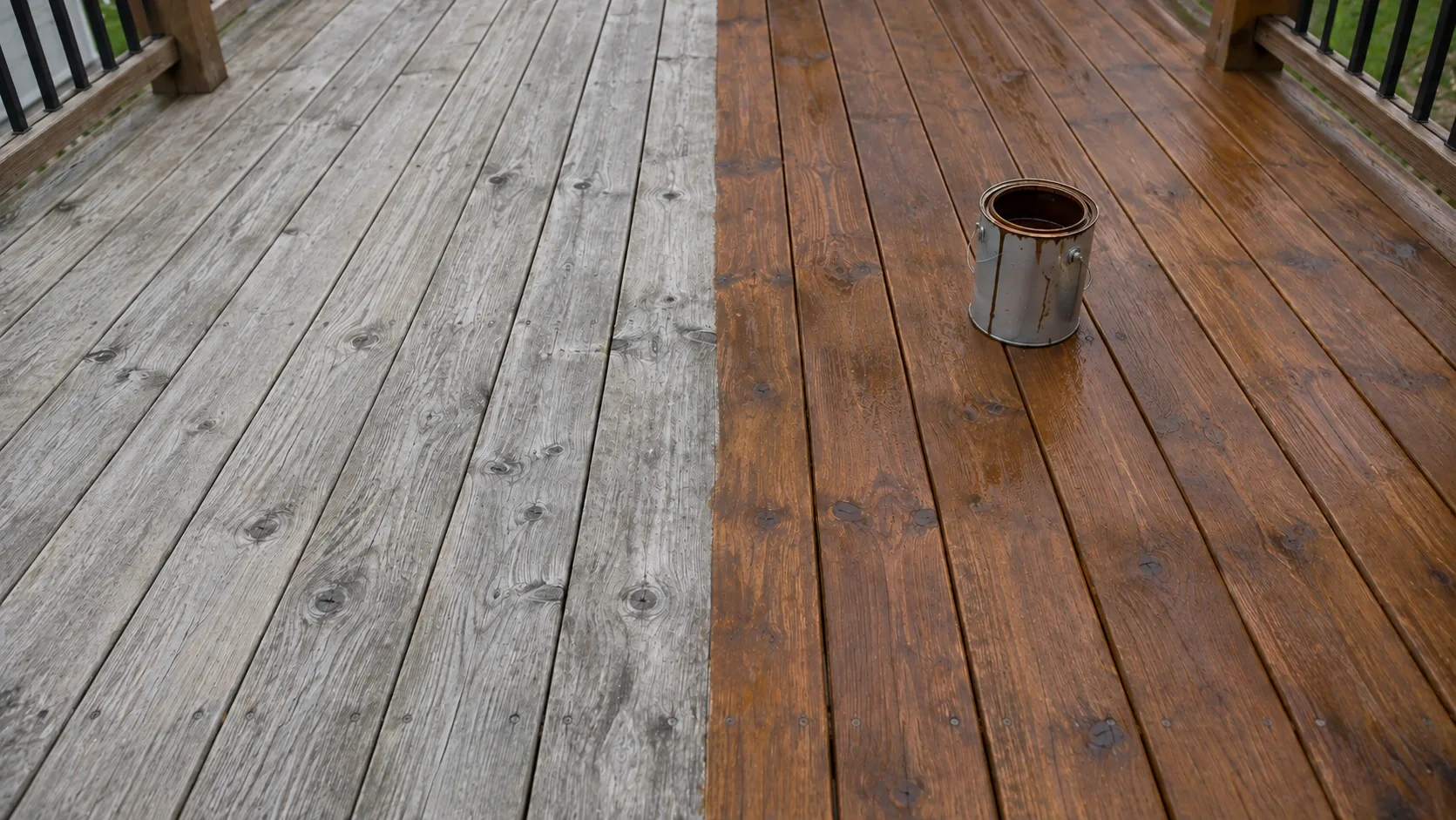
A repaired wood deck that goes straight back to being unsealed is a repeat customer, and not in a good way. Once the structure is right, get a finish on it. Our staining and sealing page covers the schedule and what it costs, and it is the cheapest thing on this site relative to what it saves you.
Where we repair decks
Across Dayton, Oakwood, Kettering, Centerville, Beavercreek and Springboro. Older Oakwood and Kettering decks are the ones where we most often find a nailed ledger, simply because of when they were built.
Deck cost in Dayton, OH
| Repair | Typical cost | When it makes sense |
|---|---|---|
| Replace surface boards only | $12 to $22 per sq ft | Frame sound, decking checked or splintered |
| Rebuild or replace railings | $45 to $110 per linear ft | Loose guards, spacing not to code |
| Rebuild stair run | $900 to $2,600 | Uneven risers, rot, no handrail |
| Correct or replace a ledger | $1,400 to $4,000 | Nailed, unflashed or rotten at the house |
| Re footing a sinking post | $600 to $1,500 per post | Deck block or shallow pier has heaved |
| Sister failing joists | $45 to $90 per joist | Localised rot, frame otherwise good |
Ranges are typical installed prices for the Miami Valley and include footings, framing, decking, railings and stairs unless noted. Your written estimate is the number that counts.
Why homeowners pick Apex Decks
Footings below the frost line
Ohio ground heaves. Every post we set lands on a poured footing below the local frost depth, which is what keeps a deck level through a decade of freeze and thaw.
Permits and inspections handled
We pull the permit, meet the inspector and hand you the signed card. An unpermitted deck becomes your problem the day you sell the house.
Written scope before we start
Materials, framing spec, hardware, timeline and price in writing before anybody swings a hammer. No verbal change orders.
Deck Repair questions we get asked
How do I know if my deck is unsafe?
Four things to check. Push hard on the guard rail at the top: it should not move. Look at where the deck meets the house for rust streaks, gaps or soft wood. Walk the deck and feel for bounce or spring. Look under it at the post bottoms and at anything sitting on a concrete block. Any one of those is worth an inspection, and the ledger connection is the one that actually causes collapses.
Is it cheaper to repair or replace a deck?
It depends entirely on the frame. If the joists, beams, posts and ledger are sound, replacing the surface and railings costs roughly a third of a full rebuild and buys you another fifteen years. If the frame is undersized, sitting on deck blocks, or the ledger was nailed on, repair is money spent on something that still has to come out later. We tell you which one you have before you pay us anything.
Can you fix just part of my deck?
Yes, and often that is the right answer. Replacing six rotten boards, rebuilding one stair run, or re footing a single sunken post are all normal jobs. Matching new treated lumber to weathered boards never looks perfect on day one, but it evens out within a season or two once everything has greyed together.
My deck bounces when people walk on it. Is that dangerous?
Usually it means the joists are undersized or over spanned for the load, or a beam has lost bearing. It is not automatically about to fail, but it is a sign the frame was built to the wrong span, and it gets worse as the wood ages. Adding a mid span beam and a line of footings often fixes it for far less than a rebuild.
Do I need a permit for deck repairs?
Like for like board replacement generally does not need one. Anything structural does: a new ledger, new footings, a rebuilt stair run, changed framing or added square footage. We tell you which side of that line your job falls on, and pull the permit when it is needed.
How fast can you get out to look at it?
Deck inspections and repair quotes are usually inside a few days, and faster if the deck is genuinely unsafe and you have told us so. If something is dangerous we will say so on the phone and tell you to keep people off it until we have looked.