Dayton, OH and the Miami Valley
Deck Railing Installation in Dayton, OH
Aluminium, cable, glass and wood guards, attached to the frame the way code expects rather than screwed through the decking. The part of a deck people actually touch.
- Footings below the frost line
- Permits and inspections handled
- Written scope before we start
Apex Decks installs deck railings across Dayton and the Miami Valley in aluminium, cable, glass and wood, bolted to the frame rather than screwed through the decking.
Railings are the most touched and most inspected part of a deck, and the one where a shortcut shows up fastest.
How a guard should be attached
A guard post needs to be connected to the frame, not to the surface. That means bolting through the rim joist or a blocked joist with hardware designed for the load, with blocking added inside the frame where each post lands. On a composite deck this has to be planned before the boards go down, because the blocking goes in during framing and cannot be added afterwards without pulling boards.
Code expects a guard to take a meaningful concentrated load at the top rail in any direction. That is a person falling into it, which is the entire point. A railing that moves when you push it is not meeting that.
The systems we install
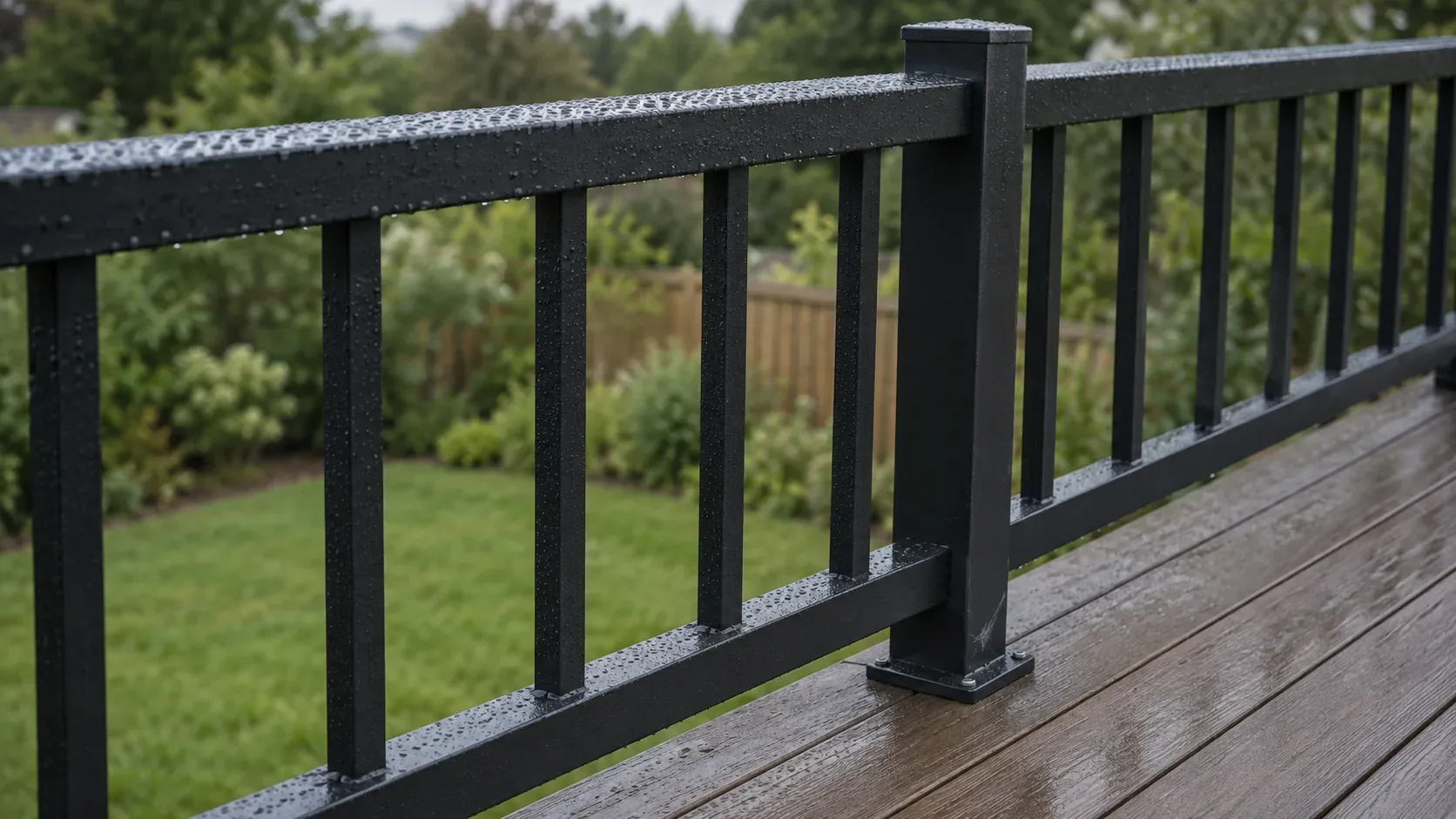
Black aluminium
The most common upgrade and the one we fit most. Powder coated, will not rust, never needs painting, and the thin profile means you see the yard instead of the railing. Works with wood, composite and PVC decking, and most systems take integrated lighting in the posts.
Wood
Treated or cedar, built on site. Cheapest to install, most expensive to keep. It is the right call on a rustic deck, where the budget has to go into square footage, and on a period house where an aluminium system would look wrong.
Composite rail
Matches composite decking in colour and needs no finishing. Heavier visually than aluminium and usually similar in price, so the choice comes down to whether you want the railing to match the deck or disappear against it.
Horizontal cable
Stainless cable in metal posts. The lightest sight line short of glass. It needs correct tensioning, stiff posts at corners and terminations, and a check after the first year because cable relaxes slightly as it settles.
Glass panel
Full panels or infill between posts. Almost invisible, and excellent on a deck with a view or an exposed windy elevation where you want a windbreak. It needs cleaning, and on a deck under trees that is a real commitment.
Stairs, handrails and the details that fail inspection
A graspable handrail
A stair run of four or more risers needs a handrail that can actually be gripped, at the height the code sets. A 2 by 6 laid flat on top of a guard is not graspable, and it is the single most common stair failure we see on decks built by a homeowner.
Consistent baluster spacing
The 4 inch sphere rule applies to the widest opening anywhere in the guard, including the triangular gap at the bottom of a stair guard, which is where people get caught out.
Post spacing
Guards are only as good as the post spacing allows. Stretching posts further apart to save money produces a rail that flexes between them, and a rail that flexes is a rail people stop trusting.
Cost, and why railing drives a deck budget
Railing is priced per linear foot, and a deck’s perimeter does not scale with its area the way people assume. A long narrow deck can carry twice the railing of a square deck with the same square footage. On an elevated deck with two stair runs, railing can be a quarter of the total build cost.
That changes two decisions. First, a ground level deck under 30 inches often needs no guard at all, which is a large saving and a real argument for keeping the deck low where the door height allows. Second, if the budget is tight, aluminium on the elevation you look at and wood elsewhere is a legitimate compromise, as long as it is planned so it reads as deliberate.
Retrofitting railings to an existing deck
Common, and worth doing on a deck where the boards are fine but the wood guards have gone soft. We check whether the frame has blocking where the new posts need to land, add it where it does not, and fit the new system.
If the existing guards were through screwed into the decking, expect the frame work to be a real part of the quote. That missing blocking is the actual job, and the railing is the easy part.
Where we install railings
Across Dayton, Oakwood, Kettering, Centerville, Beavercreek and Springboro. Aluminium is the default request in the newer Beavercreek and Springboro subdivisions, and wood still wins in Oakwood where it suits the houses.
Deck cost in Dayton, OH
| System | Installed per linear ft | Maintenance | Sight lines |
|---|---|---|---|
| Pressure treated wood | $45 to $70 | Seal every 2 to 3 years | Heavy |
| Composite rail with square balusters | $65 to $95 | Wash | Heavy |
| Black aluminium | $70 to $110 | None | Light |
| Horizontal cable with metal posts | $110 to $170 | Tension check yearly | Very light |
| Glass panel | $150 to $240 | Cleaning | Almost none |
| Add: integrated post cap lighting | $85 to $180 per post | None | n/a |
Ranges are typical installed prices for the Miami Valley and include footings, framing, decking, railings and stairs unless noted. Your written estimate is the number that counts.
Why homeowners pick Apex Decks
Footings below the frost line
Ohio ground heaves. Every post we set lands on a poured footing below the local frost depth, which is what keeps a deck level through a decade of freeze and thaw.
Permits and inspections handled
We pull the permit, meet the inspector and hand you the signed card. An unpermitted deck becomes your problem the day you sell the house.
Written scope before we start
Materials, framing spec, hardware, timeline and price in writing before anybody swings a hammer. No verbal change orders.
Deck Railings questions we get asked
How high does a deck railing have to be in Ohio?
Residential guards are 36 inches minimum measured from the deck surface to the top of the rail, and a guard is required once the walking surface is more than 30 inches above the grade below. Openings have to be small enough that a 4 inch sphere cannot pass through, which is what sets baluster spacing. Stair guards and handrails have their own rules, and your building department confirms the specifics for your jurisdiction.
Why does my railing wobble?
Almost always because the guard posts were fastened through the decking into nothing structural, or notched so heavily that very little post section is left. Code expects a guard to resist a real lateral load at the top rail. A proper post is bolted to the rim joist or to a blocked joist with hardware made for the job. Retrofitting that is a normal repair.
Is aluminium railing worth the extra over wood?
Over ten years, usually yes. A wood guard has an enormous amount of surface to coat, has to be recoated on the same cycle as the deck, and eventually the balusters split. Aluminium costs roughly 50 percent more installed and then costs nothing. It is also visually much lighter, which matters if the deck looks out over something worth seeing.
Can I have cable railing on a deck in Dayton?
Yes. Cable railing has to be tensioned properly, and the posts have to be stiff enough and close enough together that the cables cannot spread beyond the opening limit. That usually means metal posts rather than wood, with corner and terminal posts sized for the tension load. Done properly it is excellent. Done on undersized wood posts it fails inspection.
Do I need a railing on a low deck?
Not if the walking surface stays under 30 inches above the grade below, which is one of the strongest arguments for a ground level deck if budget matters. You still usually want a handrail on any stair run of four or more risers.
Can you add lighting to the railings?
Yes, and it is far cheaper to do during the railing install than afterwards, because the wiring runs inside the posts and rails. Post cap lights, under rail strips and recessed riser lights are all normal.