Dayton, OH and the Miami Valley
Paver Patios and Hardscapes in Dayton, OH
Paver patios built on a base deep enough to survive an Ohio winter. Often the cheapest way to add usable outdoor space, and the right answer for a fire pit or a grill.
- Footings below the frost line
- Permits and inspections handled
- Written scope before we start
Apex Decks builds paver patios and hardscapes across Dayton and the Miami Valley, on a base deep enough to survive an Ohio winter.
Not every outdoor space should be a deck. Where the door sits close to grade, a patio gives more usable square footage per dollar and takes a fire pit safely.
What goes under the surface
Excavation and subgrade
Down to solid, undisturbed subgrade, which on the clay that runs through much of this area means digging deeper than the quote from someone working to a minimum. Soft spots get removed rather than filled over.
Geotextile
A separation fabric between subgrade and base on clay soils, which stops the aggregate migrating down into the soil over time. Cheap, quick, and the reason a base keeps its depth for twenty years instead of eight.
Compacted aggregate base
Typically 6 to 8 inches for a patio, placed and compacted in lifts rather than dumped and rolled once. Each lift compacted properly is what produces a surface that does not settle unevenly.
Bedding and edge restraint
A thin screeded bedding layer, then the pavers, then an edge restraint spiked into the base around the perimeter. Without edge restraint the outer course creeps outward every year and the whole field loosens behind it.
Polymeric joint sand
Swept in, activated with water, and it hardens in the joint. It locks the pavers, resists washout and keeps most weeds out. It needs topping up every few years and anyone who tells you otherwise is selling.
What we build
Patios
Concrete paver in the usual range of formats and colours, or natural stone where the budget and the house suit it. Bluestone on an older Oakwood property reads correctly in a way that a modern paver often does not.
Walkways
Front paths, side access, and the run from a deck stair down to a patio. Narrow work costs more per square foot than open field because the edge and cutting work per unit area is higher.
Seat walls and retaining
A seat wall gives permanent seating around a fire pit without furniture, and on a slope it doubles as low retaining. Anything above a certain height becomes an engineered retaining wall with its own permit and drainage requirements.
Fire pits
Wood burning or gas. A built in wood pit on pavers is straightforward and is one of the main reasons to choose a patio over a deck extension, since an open fire on a composite or wood deck is not something we will build. Gas features need a line run and usually a permit.
Steps between deck and patio
The transition is where these projects are won or lost. A landing that does not hold water, a consistent rise across every step, and a surface that is safe wet.
Where a patio beats a deck, and where it does not
Flat ground and a door close to grade favour the patio. Sloping ground and a raised door favour the deck, because a deck steps over a problem that a patio has to regrade or retain.
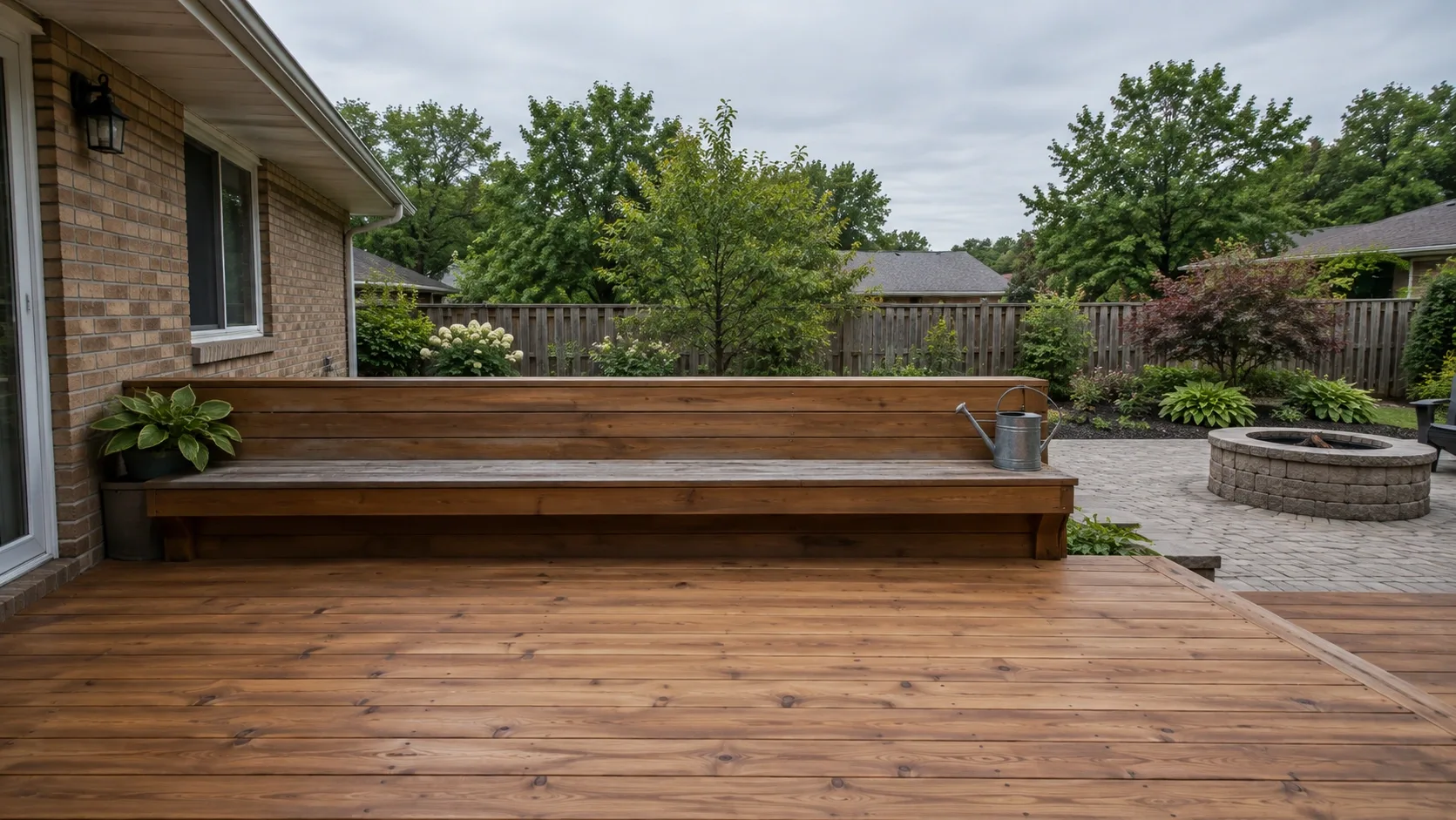
The best answer in many Miami Valley back yards is both. A deck at the door for the table and the grill, steps down to a patio for the fire pit, and the two sized so each does one job well. It usually costs less than one very large deck and it is a much better place to spend an evening.
A pergola over a patio is the cheapest way to make the lower space feel like a room.
Where we build patios
Across Dayton, Oakwood, Kettering, Centerville, Beavercreek and Springboro.
Deck cost in Dayton, OH
| Element | Typical cost | Notes |
|---|---|---|
| Concrete paver patio | $18 to $30 per sq ft | Base depth drives the number |
| Natural stone patio | $28 to $48 per sq ft | Bluestone, flagstone, irregular or cut |
| Paver walkway | $22 to $38 per sq ft | Narrow work costs more per foot |
| Seat wall | $110 to $190 per linear ft | Doubles as retaining on a slope |
| Fire pit, built in | $2,400 to $6,500 | Gas needs a line run and a permit |
| Steps from a deck to a patio | $900 to $2,800 | Landing and drainage matter |
Ranges are typical installed prices for the Miami Valley and include footings, framing, decking, railings and stairs unless noted. Your written estimate is the number that counts.
Why homeowners pick Apex Decks
Footings below the frost line
Ohio ground heaves. Every post we set lands on a poured footing below the local frost depth, which is what keeps a deck level through a decade of freeze and thaw.
Permits and inspections handled
We pull the permit, meet the inspector and hand you the signed card. An unpermitted deck becomes your problem the day you sell the house.
Written scope before we start
Materials, framing spec, hardware, timeline and price in writing before anybody swings a hammer. No verbal change orders.
Paver Patios questions we get asked
Is a paver patio cheaper than a deck?
At ground level, usually yes, at roughly 18 to 30 dollars per square foot against 22 to 34 for a treated deck and considerably more for composite. The gap widens as the ground gets flatter and narrows fast as it slopes, because a patio on a slope needs retaining and grading that a deck simply steps over. On a walkout lot a deck is often cheaper than the excavation a patio would need.
How deep does the base need to be in Ohio?
Deeper than most quotes assume. We build on a compacted aggregate base, typically 6 to 8 inches for a patio and more for anything carrying vehicles, over a properly prepared subgrade, with geotextile between where the soil is clay. Ohio freeze thaw finds every shortcut in a base, and a patio that heaves after two winters was almost always under built below the surface.
Will the joints grow weeds?
Far less with polymeric sand, which hardens in the joint and resists both weed seed and washout. It is not permanent. Expect to top up joints every few years, particularly along edges and anywhere water runs across the surface. Regular sand is cheaper and will give you weeds within a season.
Can I have a fire pit on a paver patio?
Yes, and it is one of the better reasons to build a patio rather than extend a deck, because a wood burning fire pit on a combustible deck surface is a genuine problem. Clearances from the house, from the property line and from anything overhead still apply. A gas fire feature needs a line run and usually a permit.
Deck or patio?
If the door is close to grade and the ground is reasonably flat, a patio gives you more square footage per dollar. If the door is a metre or more above grade, or the ground falls away, a deck is cheaper because it steps over the problem instead of regrading it. A lot of the best back yards we build are both, with a deck at the door and a patio below connected by steps.
Do you need a permit for a patio?
A ground level patio usually does not, though zoning rules on lot coverage and impervious surface can still apply, particularly in the newer subdivisions. A retaining wall above a certain height, and any gas line for a fire feature, do need permits. We check before we start.